Google · 2018–2019
Price context before the first call
Created content rules that turned raw pricing spreadsheets into readable pricing cards across US ZIP codes.
- My role
- UX Writer & Content Strategist
- Period
- 2018–2019
- Project focus
- Content modeling · UX writing
At a glance
Project summary
The problem
Customers needed local price context before calling; partner spreadsheets were not ready for the UI.
My contribution
Defined spreadsheet formats and sentence patterns with Homewyse so Engineering could import the data.
Key decision
Use compact sentence patterns and put ZIP codes in titles to make local relevance clear.
Outcome
Shipped on mobile; the design became a framework for additional educational content.
I turned extensive pricing spreadsheets into a reusable content pattern for Google Local Services. The work connected raw partner data with the information customers needed before calling a small business: what a job typically costs, what that price includes, and whether it applies locally.
The challenge
Local Services charged businesses per lead for calls placed through the product. Small businesses were receiving calls from people who were still price shopping, creating frustration on both sides.
Our partner, Homewyse, had extensive raw pricing data in spreadsheets, with no UI or organization ready for the product. The underlying data covered thousands of pricing details across services such as water-heater installation, plumbing, housekeeping, and yard services. My responsibility was to design a container and content rules that could turn that data into useful pricing cards across US ZIP codes, with possible global expansion in mind.
Build a content pattern for raw data
I created the content template and style guide, working directly with Homewyse to tailor the language their data would feed into. We met in person and reviewed content in batches.
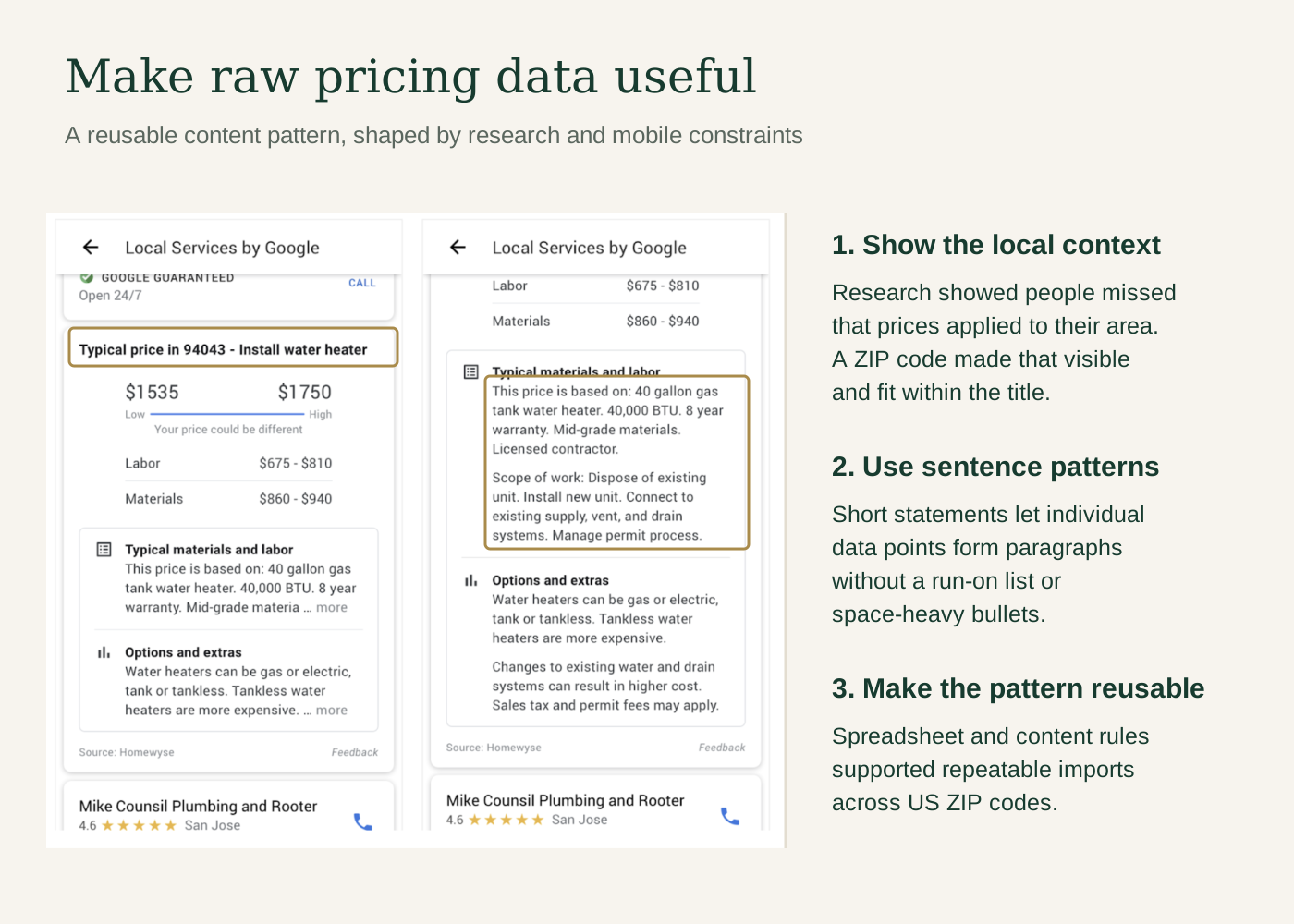
The card needed to communicate detailed pricing context without becoming a run-on list. Bullet points would use too much vertical space on a mobile screen. I worked with the partner to develop sentence patterns so individual data points could stand on their own and combine into readable paragraph descriptions.
The result was a repeatable structure for turning data into user-friendly text, rather than writing every card as a separate piece of copy.
Structure the spreadsheets for nationwide use
We sat down with Homewyse and reviewed spreadsheets of its data together. I worked with the partner to establish how the spreadsheets should be formatted so Engineering could import the pricing data for ZIP codes across the US.
That made the source structure part of the content-design problem. The spreadsheet format and language rules needed to work together so imported data could fit the same UI pattern across locations and service categories.
Make each data point readable in context
The descriptions needed to explain the assumptions behind a price and the factors that could change it. In the example, short statements such as “Mid-grade materials. Licensed contractor.” make individual details readable within a compact paragraph.
The language rules let the data fit into the content pattern while keeping the result useful to someone considering a service. The structure supported detailed information without requiring a long list of bullets.
Make local relevance visible
In research, people did not recognize that the prices applied to their own area until we added ZIP codes to the titles. That finding changed how we presented the location.
ZIP codes also solved a layout constraint: some city names were long enough to run beyond the available title space. The shorter location cue made local relevance visible without relying on a city name that might not fit.
 View larger
Outcome
The pricing cards shipped on mobile and received positive press. The design also became a framework for additional educational content.
This work combined content modeling, language rules, partner collaboration, and research-informed iteration to make detailed pricing data useful before a customer called.